Semi-free FOSS
By Sean E. Russell on on Permalink.
I have a question for all you folks out there writing semi-free (as in beer) software: do you re-distribute a portion of your proceeds to all of the FOSS software you use to create your project? If not, why not?
Whenever I write software, I think of the tremendous stack of software that enables such development.
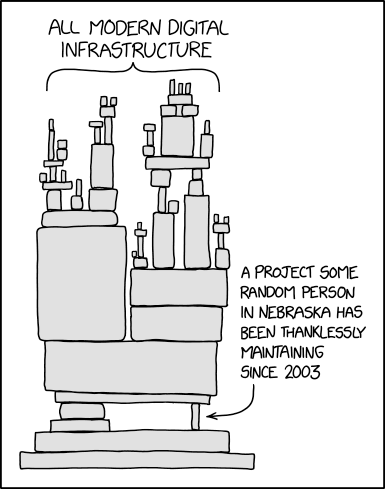
Let’s say we entirely ignore the kernel itself. And all of the GNU tools. What about tools that are more immediate to the development process: The compiler? I’m not sure I would even know how to give money to the Go development team Mercurial/jj/pijul? patch? diff? Your line-counter, benchmark tool, vetting tools, flame graph visualizer, linter, language server? How about even more intimate dependencies: all of the libraries your project uses, the third-party GUI, TUI, flags, database, mocking, DOA… do you financially recognize all of the work which allows you to produce your software? Do you pass any of that revenue on?
I’m pretty judgey, but not in this case. All of the software I write is given away gratis because I can’t figure out how I’d justify charging for it or fairly evaluate what percentage each given component contributed to the final result, as much as for any other reason.
The dream of becoming independent developers, working on projects we love, beholden only to our users (insofar as we’re beholden to anyone) I think appeals to most of us True Programmers (as in “True Scotsman”): I suspect most of us who are passionate about software development not because of a hope of becoming stupidly wealthy from it, but because we love computer programming. I suspect that most of us True Programmers, if given the choice of a reasonably middle- class income and being able to have full control over which software we work on, and how we do it, vs getting more money to be would choose a lesser salary. And if you wouldn’t, you’re Not A True Deveploper!
For myself, I decided a while ago that the model I was most comfortable with was the Sourcehut one: the software is free, and you charge for the service. For me, software is amortized over infinity, because every line of code is written exactly once. Duplication is effectively free. Service, on the other hand, costs. Every customer who calls in for help costs, every byte served by a servers costs. For a service, you can perform a reasonable cost, overhead, and profit calculation, and set a price. But if I write a 10-line program for myself, what’s the value of that program? It seems irrational to me because I am not a laissez faire capitalist that there’s a cost-per-line that can be assigned to the program, because whether 0 people find it useful or 8 billion people find it useful, it costs me exactly the same amount of effort. “Because I can” is a really stupid economic model justification.
So how do all y’all, who are trying to become financially independant by monetizing your FOSS projects and aren’t splitting your revenue with all of the projects that enable yours, justify that to yourselves?
I really need to add some sort of comment engine to my site; until I do, it’ll have to remain a rhetorical question.